

Opening the chatbot
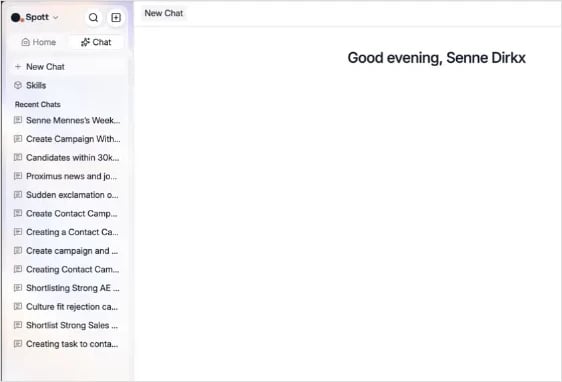
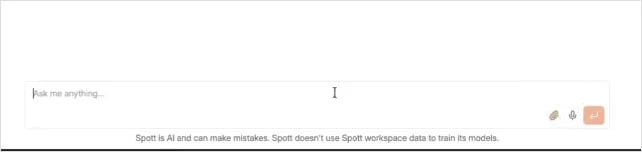
Once the chatbot is enabled for your workspace, it sits at the top left of the sidebar, under Chat. That opens a chat section listing your recent chats, so you can pick up an earlier conversation where you left off. Start a New Chat to open the chat box. From there you can:- Type your question or instruction, the easiest way.
- Dictate it with voice input, using the microphone button.
- Add attachments, such as CVs or other documents, using the paperclip button.
From a record page
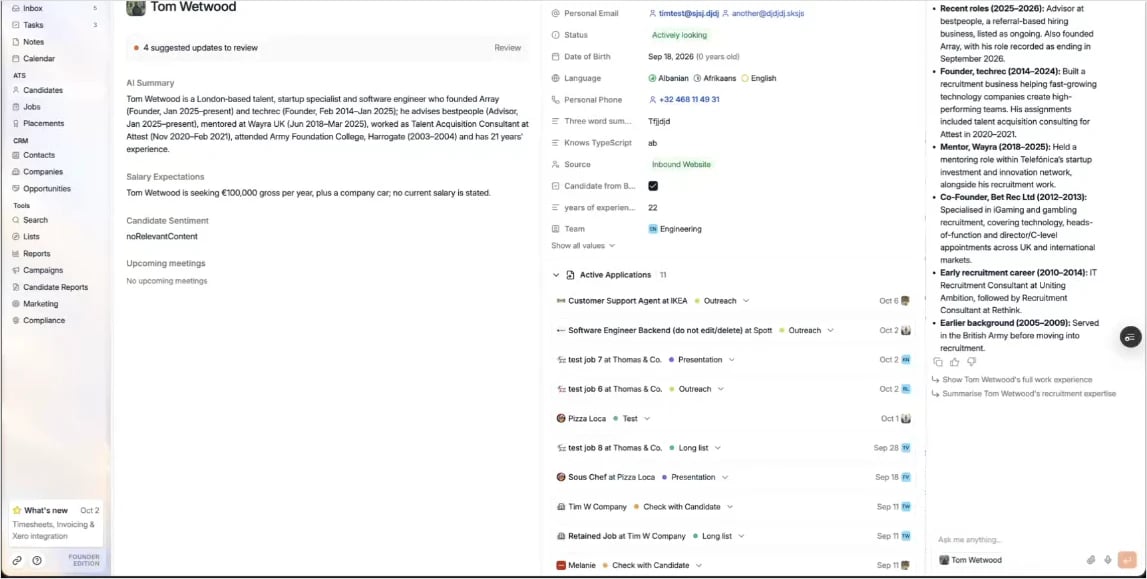
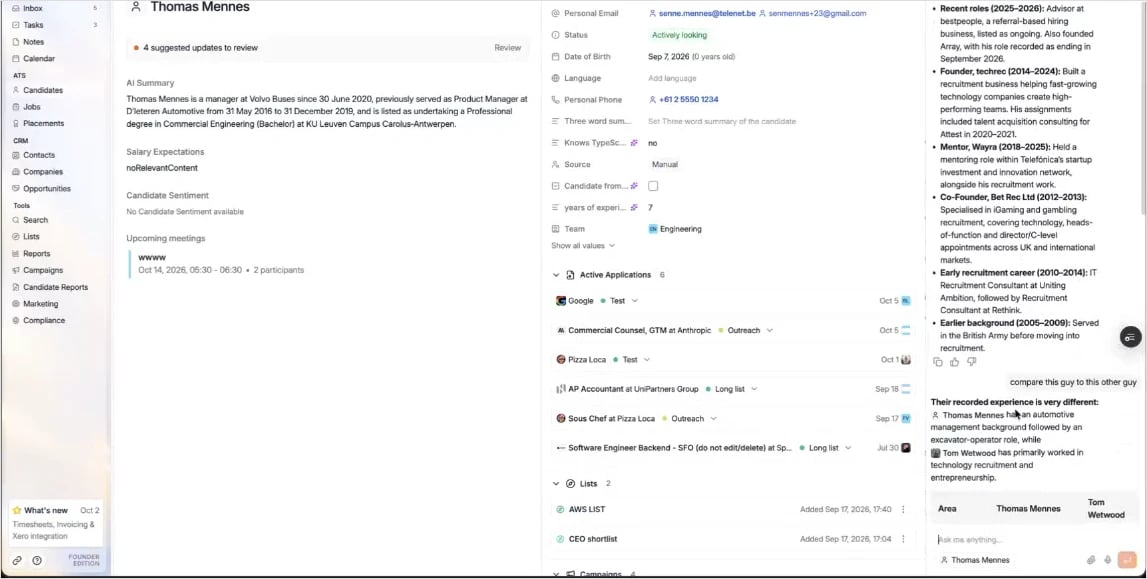
The chatbot is also always available in the side panel, through Ask AI, with exactly the same capabilities. The main chat window gives you the most room; the side panel is handy when you are working on one specific record. When you open the side panel on a candidate, contact, company or job, the context of that record is pre-filled. So you can simply ask:Recap his experience.The chatbot knows you mean the person whose page you are on. You can still ask about any other record too, for example to compare the current candidate with someone else:
Compare this person to [other candidate].
Asking your first question
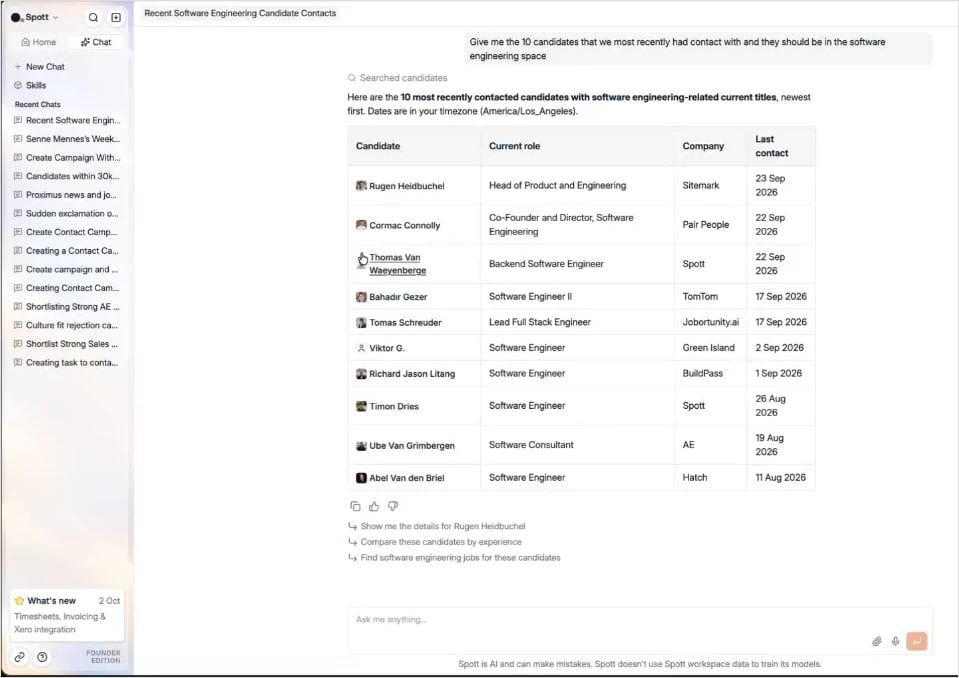
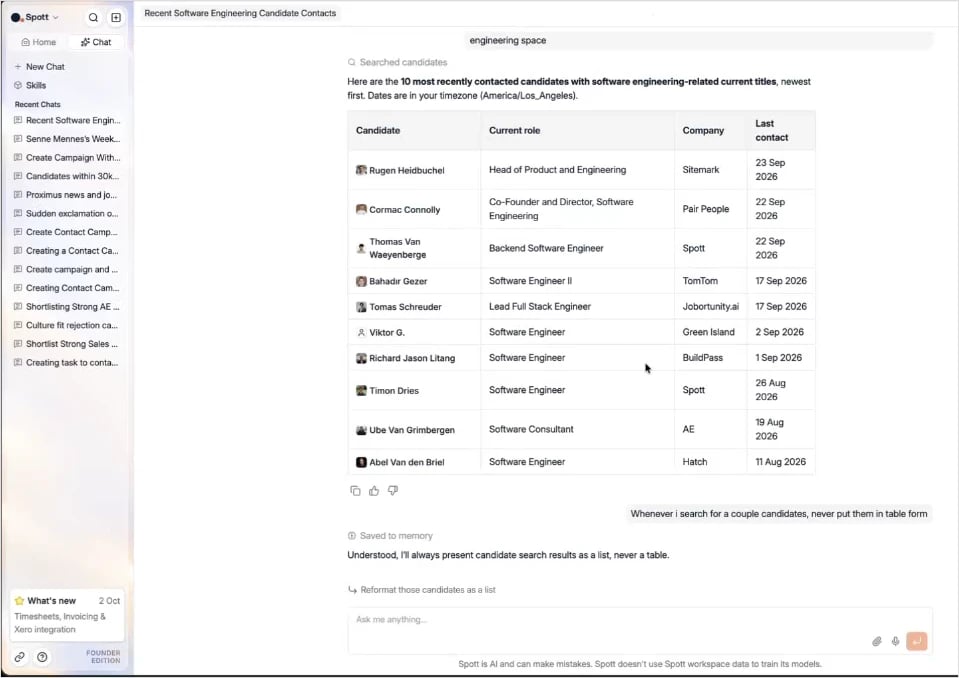
The simplest way to start is to ask for records, the same way you would describe a filter to a colleague:Give me the ten candidates we most recently had contact with who are in the software engineering space.Behind the scenes, the chatbot translates your question into the same filters you can apply manually in Spott, picks the ones that best match, and applies them. Every filter in Spott is supported, so your questions can be as detailed as you like. The answer comes back as a list or a table. Every record in it is clickable and opens in a new tab.
You stay in control of actions
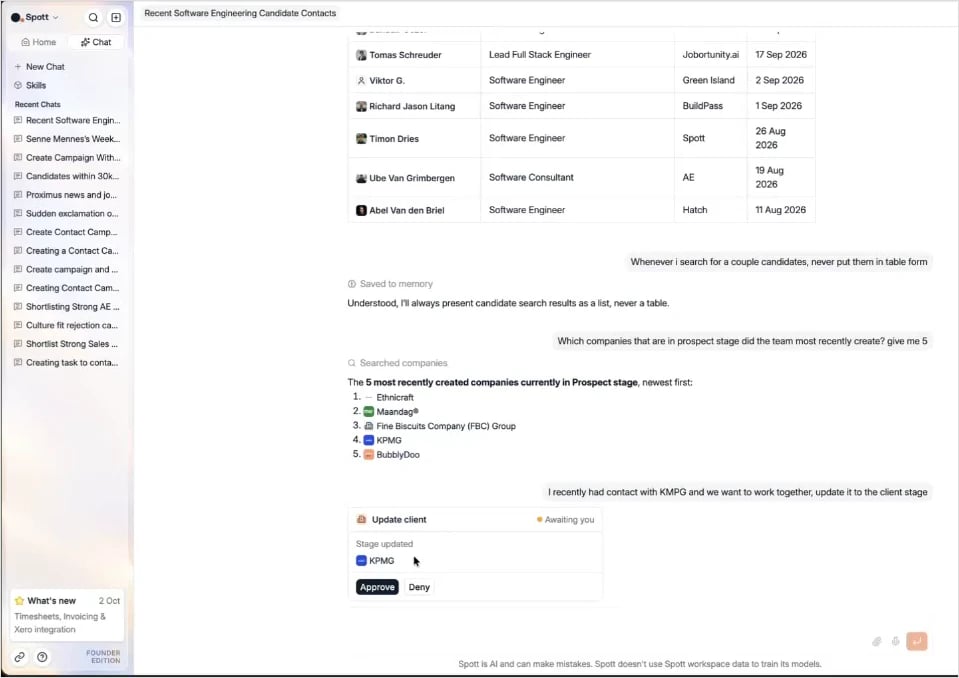
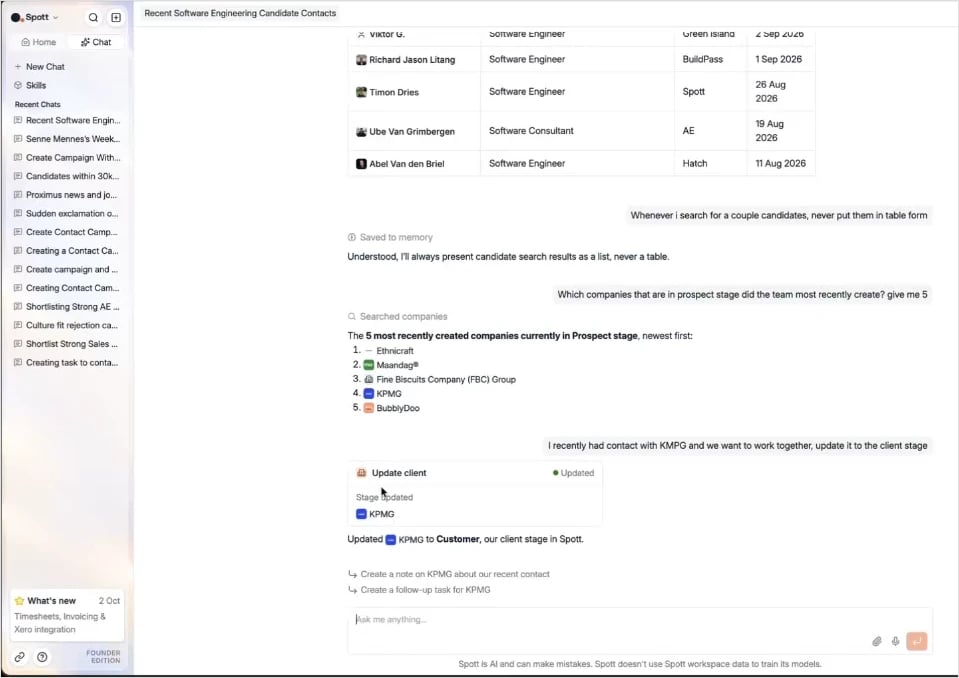
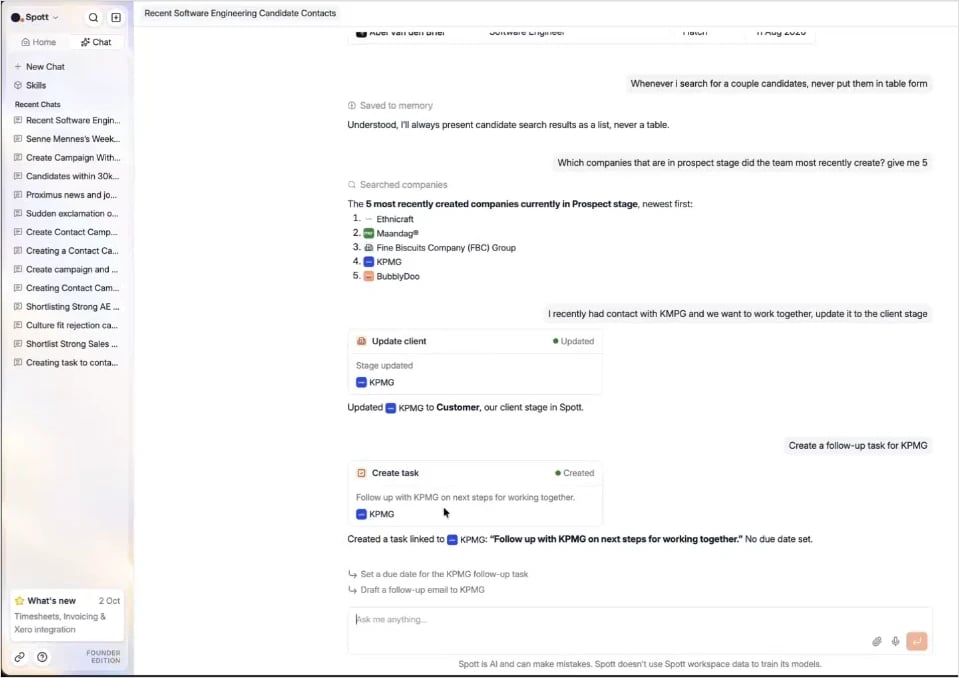
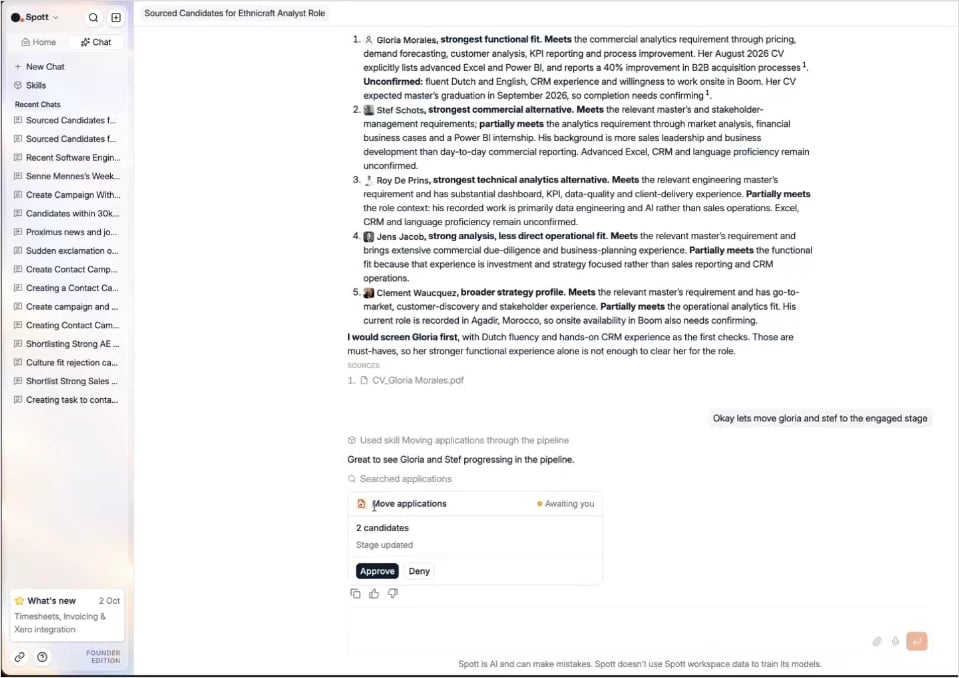
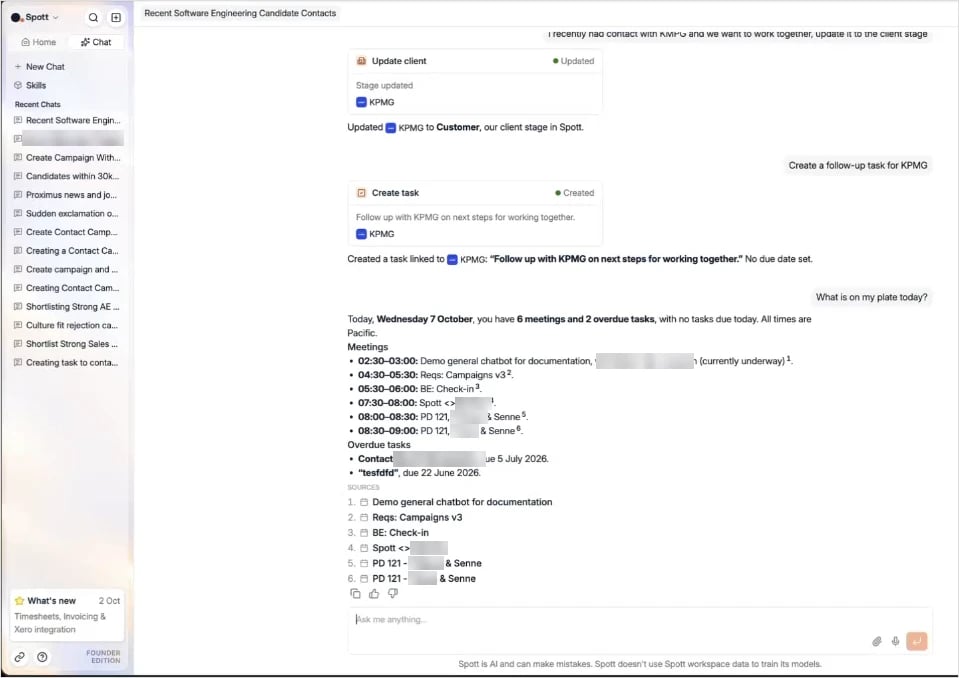
Whenever the chatbot wants to change something in Spott (create, update, move or import a record), it first shows you an approval request. Nothing changes until you click Approve.I recently had contact with KPMG and we want to work together. Update it to the client stage.If the stage you mention does not exist under that exact name, the chatbot picks the closest matching stage in your pipeline, here Customer. After an action, the chatbot suggests logical follow-ups, such as creating a follow-up task. Click a suggestion to run it.
What you can do with it
Search and count records
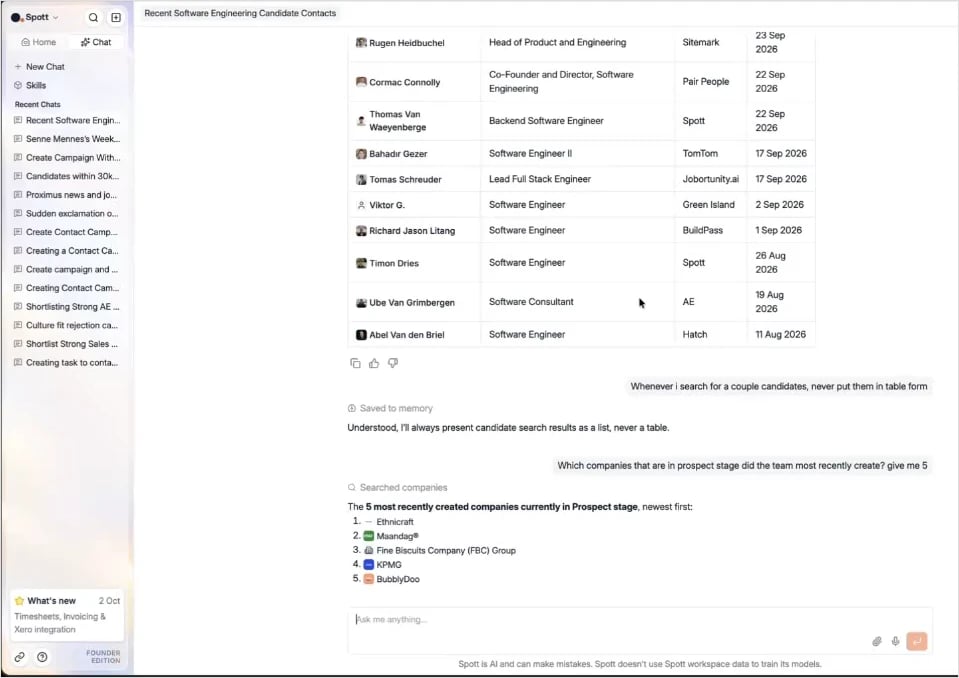
Search and count candidates, contacts, companies, jobs, opportunities, applications, notes and tasks, combining as many filters as you need.Which companies in the prospect stage did the team most recently create? Give me five.
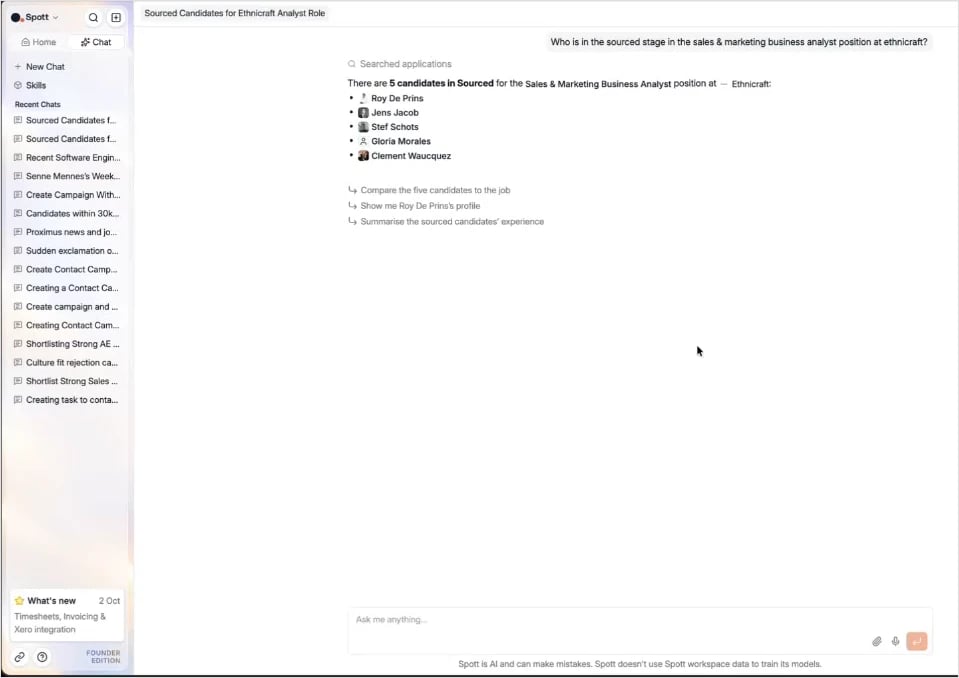
Who is in the Sourced stage for the Account Manager position at [company]?You can also ask for numbers instead of lists:
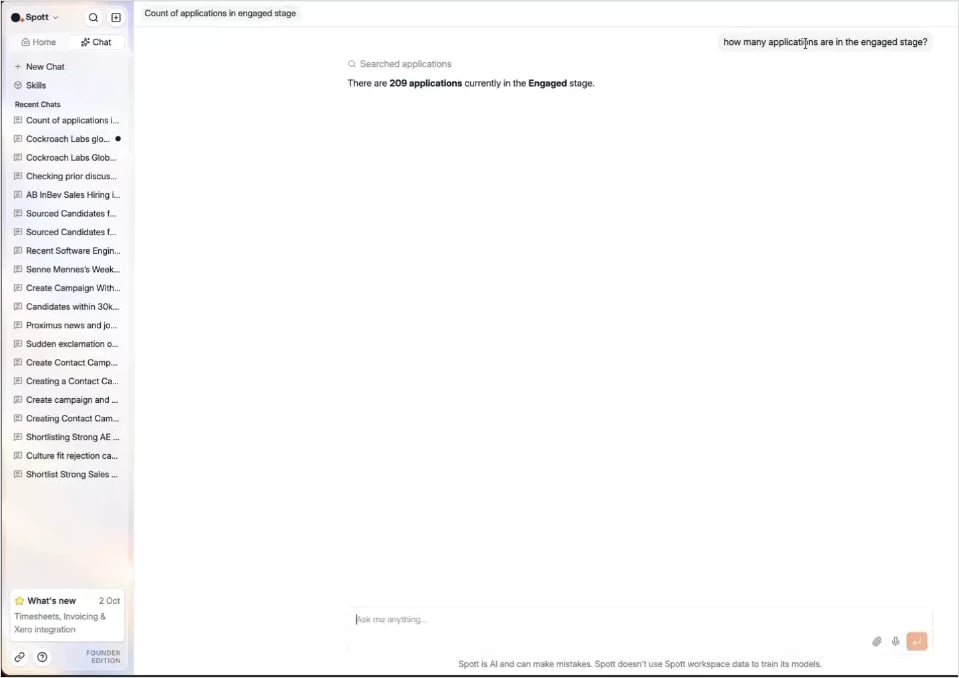
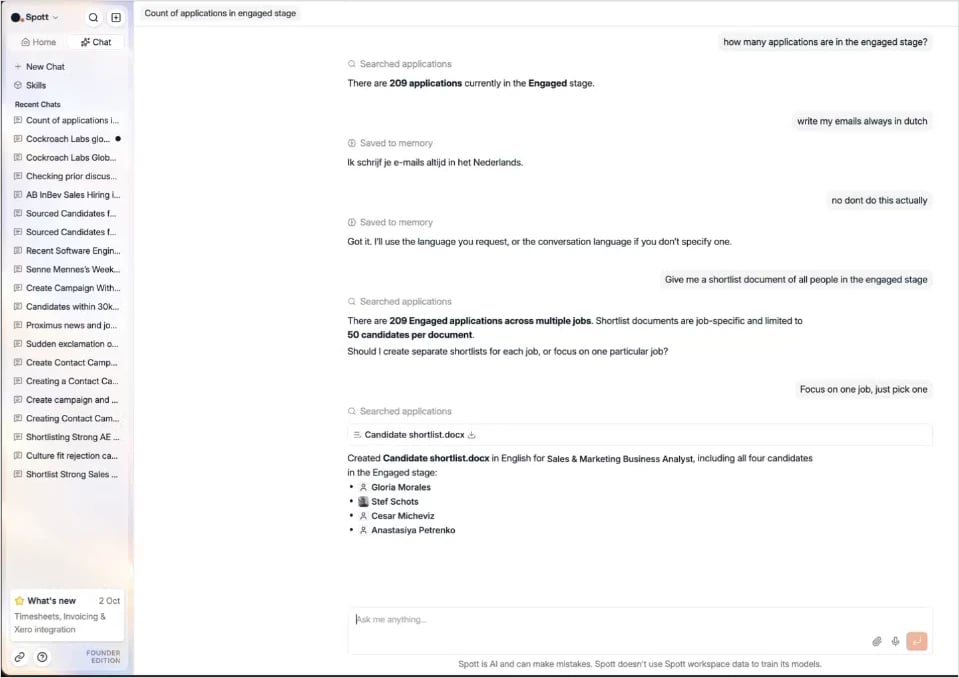
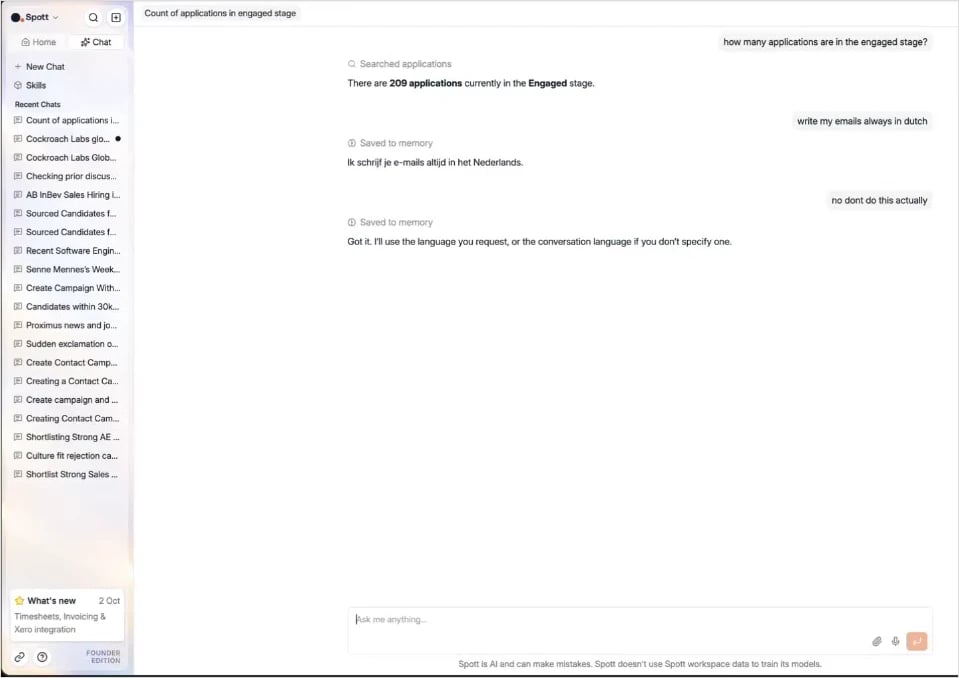
How many applications are in the Engaged stage?
How many applications were in the Engaged stage but were withdrawn by the candidate?
Create and update records
The chatbot can create and update candidates, contacts, companies, jobs, opportunities, applications, notes and tasks. For applications, it can move candidates to another stage or reject them.Move [candidate A] and [candidate B] to the Engaged stage.
Reject [candidate] for the [job] position.
Create a task to follow up with [contact] next Monday.
Add a note to [candidate]: prefers hybrid work, available from January.
Add records to lists and sequences
Add records to an existing list, or let the chatbot create a new list for you. You can also add contacts or candidates to a sequence (campaign).Add these five candidates to a new list called “Senior Java Q4”.
Add [contact] to the [sequence name] sequence.
Check your calendar and tasks
Ask what your day looks like:What is on my plate?The chatbot checks your tasks and calendar for yesterday and today. It points out what may still need a follow-up from yesterday and lists what is planned for today. Times are shown in your own time zone.
Find information in conversations
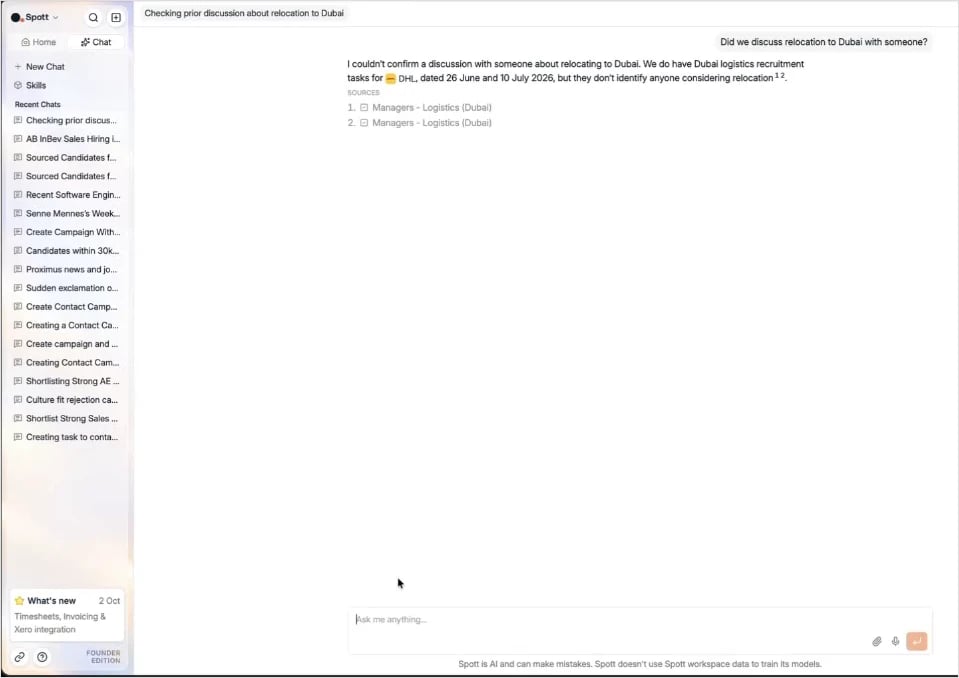
The chatbot searches by meaning, not just by exact keywords, across everything in Spott: emails, notes, tasks, comments and call transcripts. Use it to find what was said, and by whom.Did we discuss relocation to Dubai with anyone?
Is there anyone who said they want to relocate to Dubai?
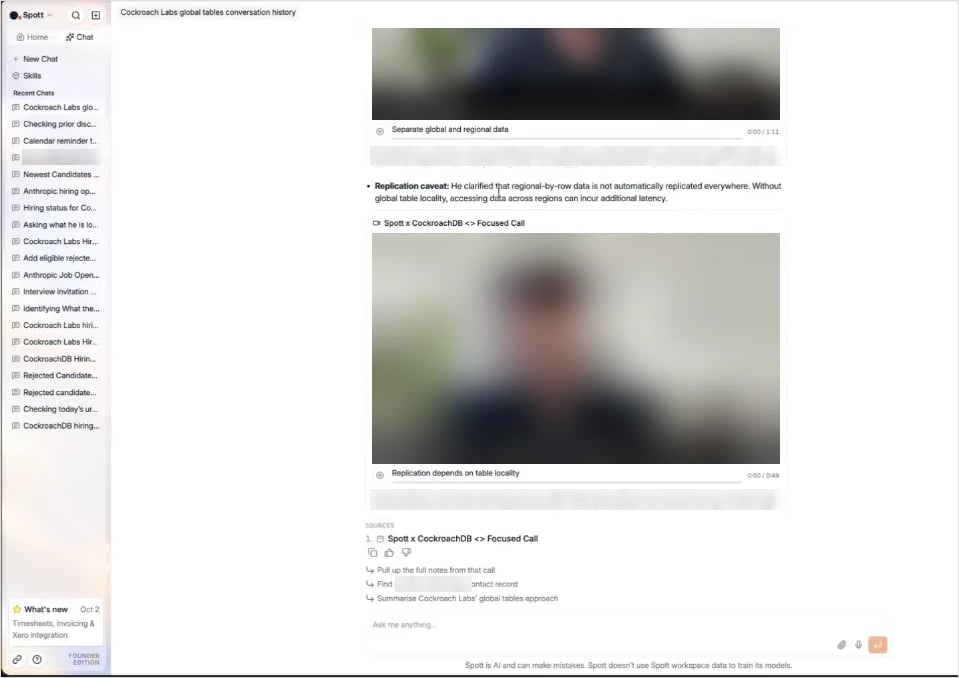
Where did he say that?When an answer is based on specific records, the sources are listed at the bottom. Click a source to open it. For calls, the chatbot points to the exact moment in the conversation, with a timestamp for each relevant snippet. This works for meeting recordings (video) as well as VoIP calls (audio).
I’m working on a job for [client]. Did we ever discuss [topic] with anyone?
The chatbot is focused on recruitment work. If a question could look unrelated to
recruitment, add a bit of context, for example “I’m working on a job for [client]”, so it
knows why you are asking.
Match candidates and jobs
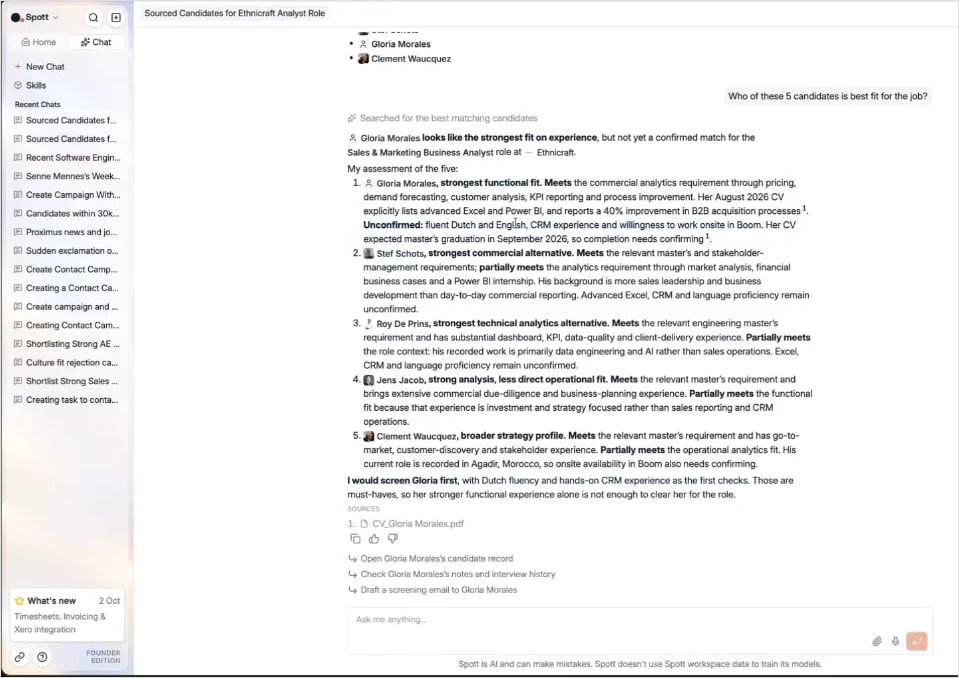
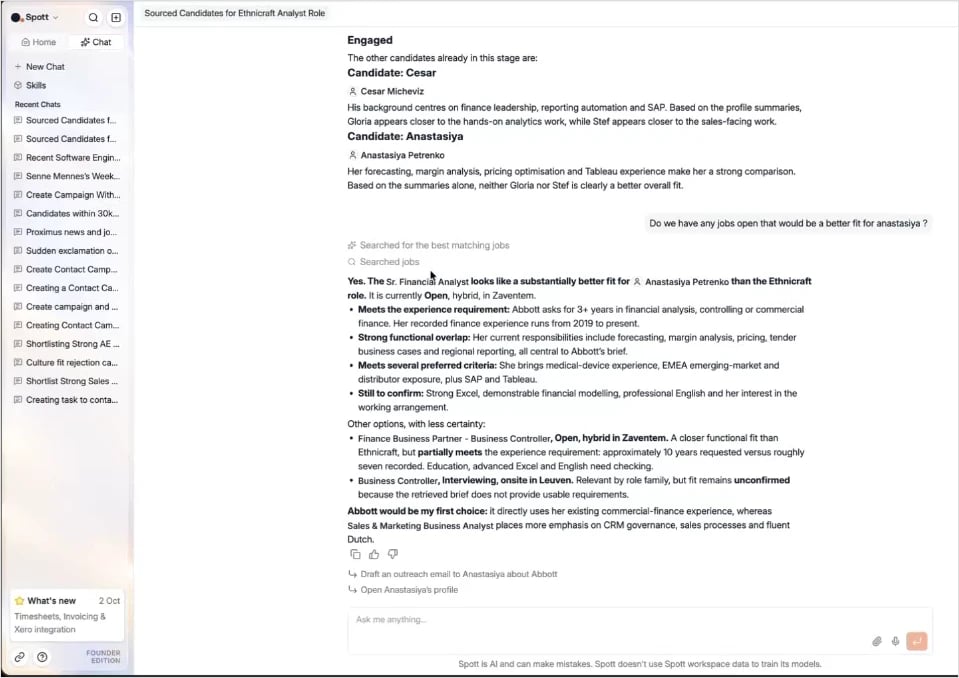
Find the best candidates for a job. The chatbot ranks the candidates and explains, per candidate, why they are or are not a good fit.Which of these five candidates is the best fit for the job?Find the best jobs for a candidate. It works the other way around too:
Do we have any open jobs that would be a better fit for [candidate]?Matching against a large pool of candidates can take a little longer than a regular search.
Work with files
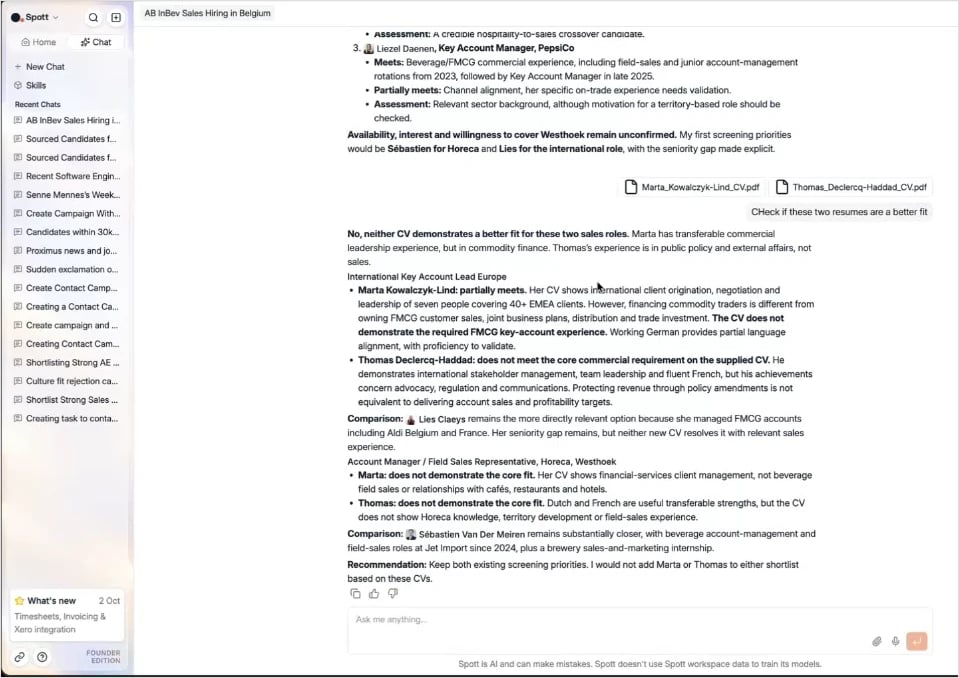
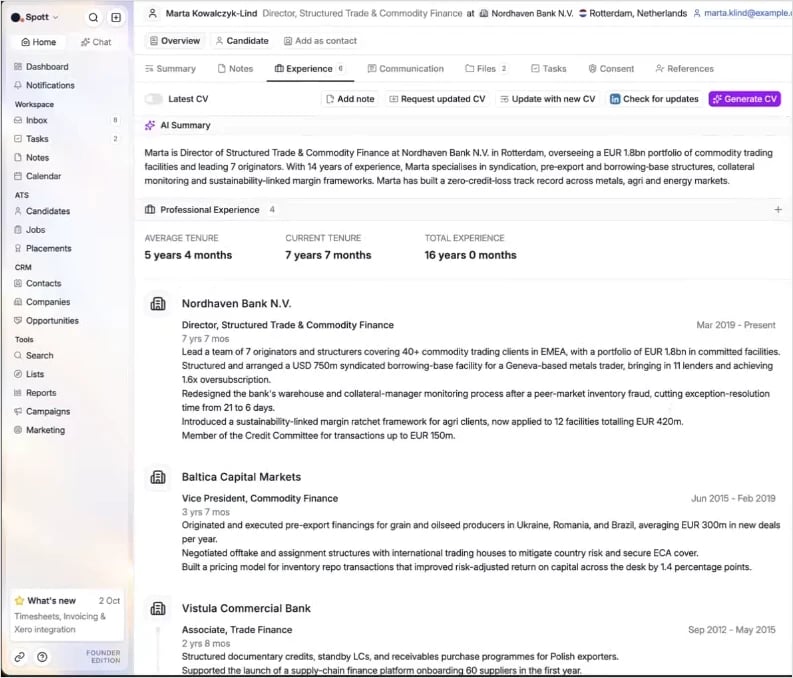
Attach files to your message with the paperclip button in the chat box. Read file contents. The chatbot reads attached documents and uses them in its answer, for example to check CVs against a job:Check if these two resumes are a better fit for the job.Create candidates from a CV. The chatbot parses the CV and creates the candidate, including their work experience.
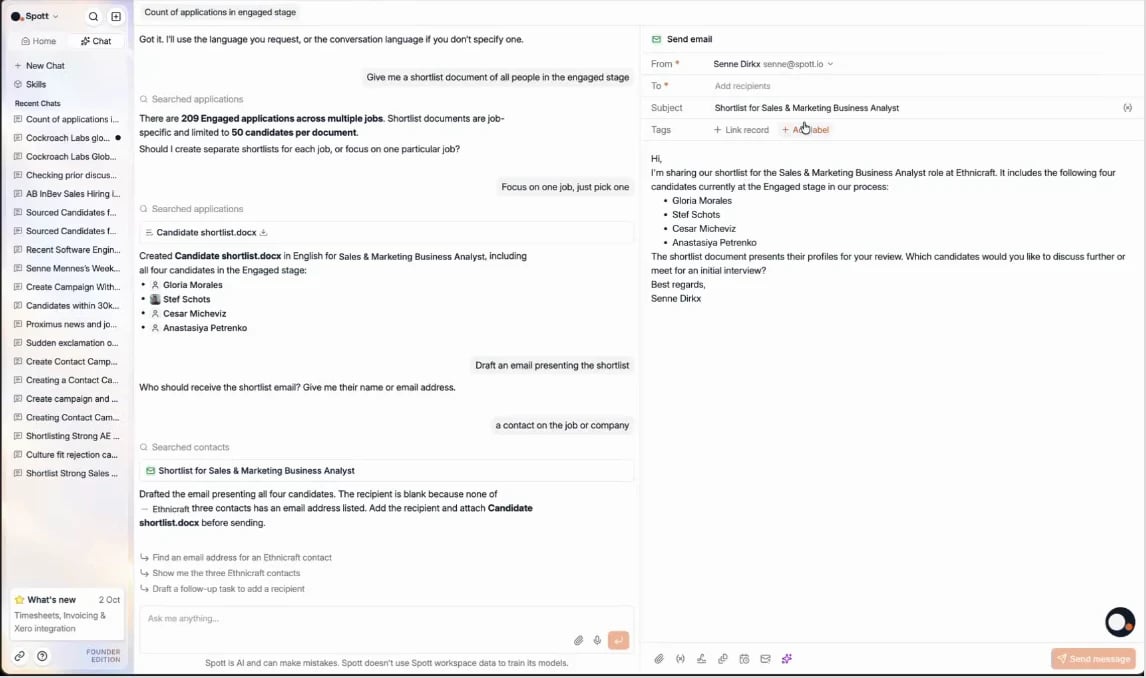
Add them as candidates.Create a shortlist document. The chatbot fills in your workspace’s shortlist template with the candidates you choose.
Give me a shortlist document of all people in the Engaged stage for the [job] job.
Draft emails and calendar events
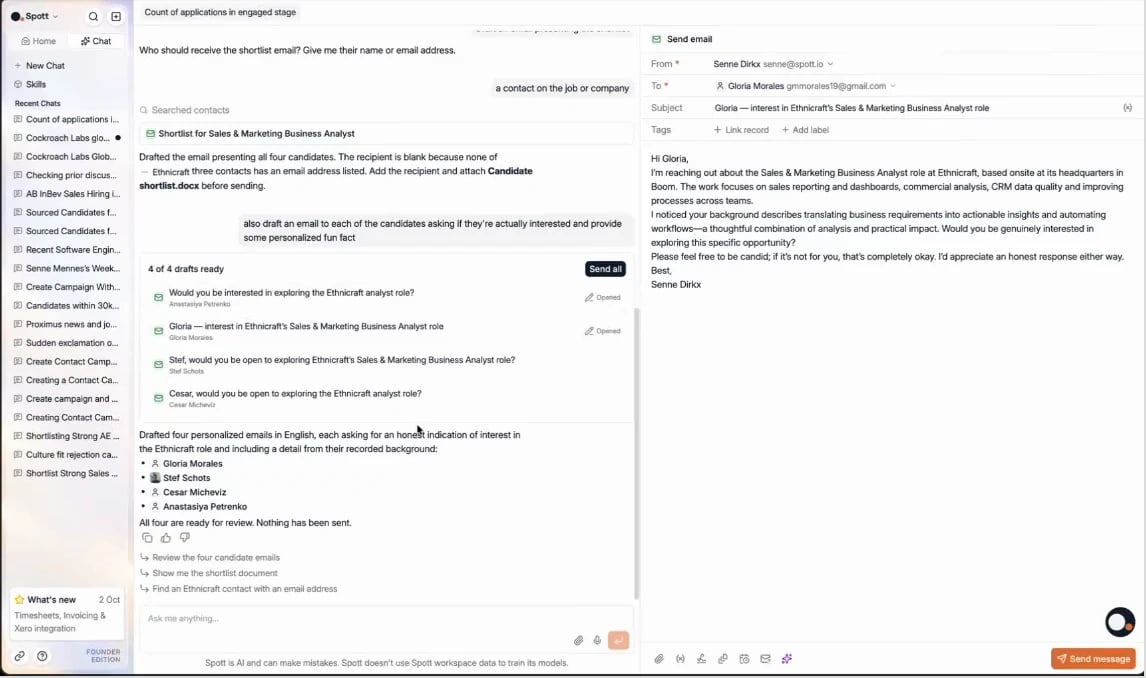
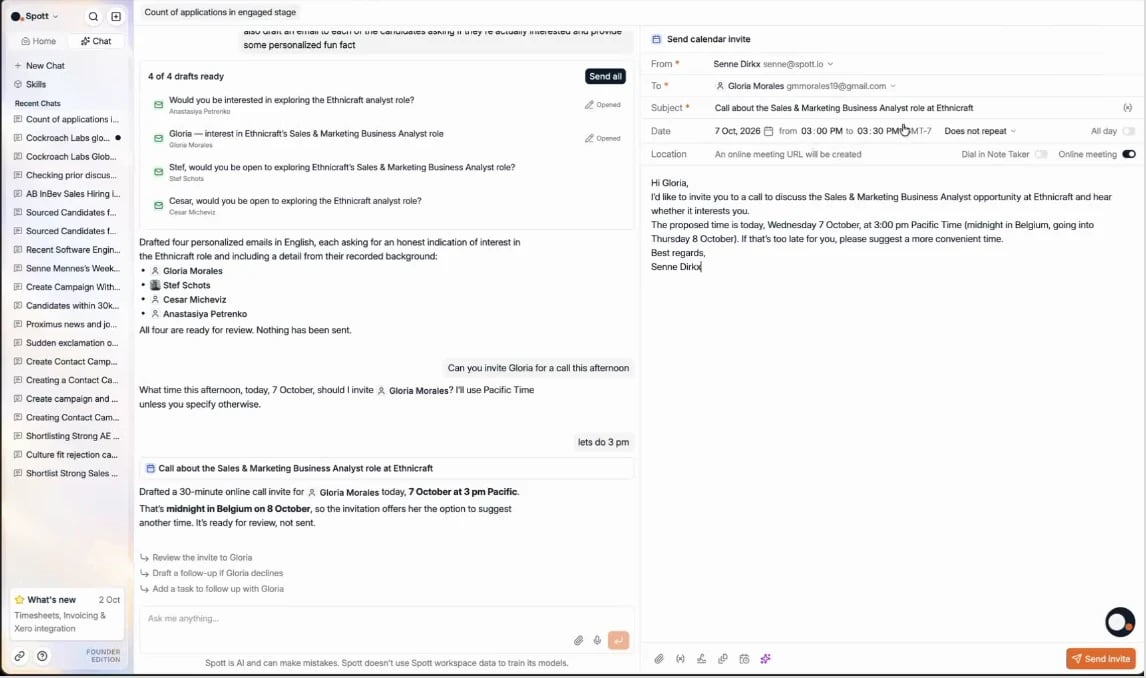
The chatbot drafts emails and calendar invites for you. Drafts are never sent automatically: you review them and send them yourself. A single email:Draft an email presenting the shortlist to the hiring manager.If a contact has no email address in Spott, the chatbot tells you. Personalized emails to several people. Each email is written individually, so every recipient gets a message tailored to them and personal details never mix between emails.
Draft an email to each of the candidates asking if they’re interested, and include a personalized fun fact.Calendar events:
Draft a 30-minute online call with [candidate] tomorrow at 3 PM about the [job] role.
Search the web and import the results
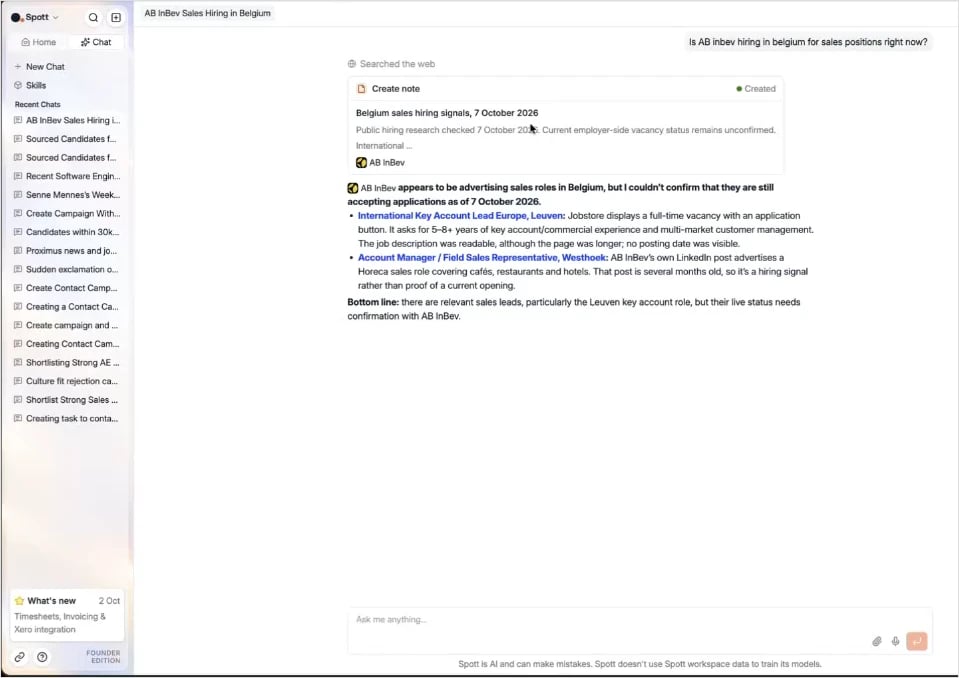
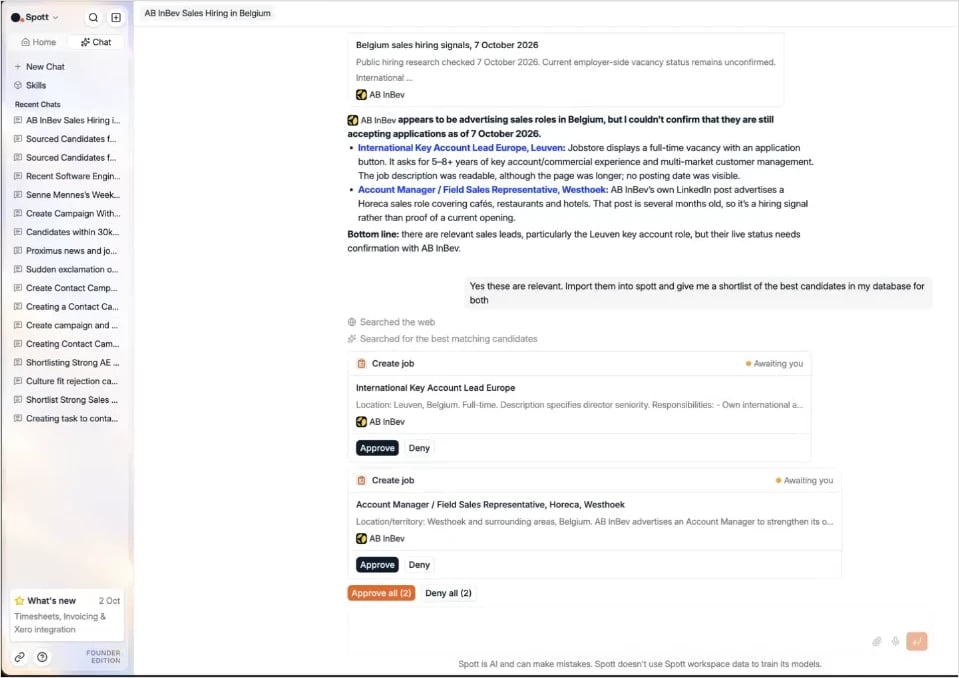
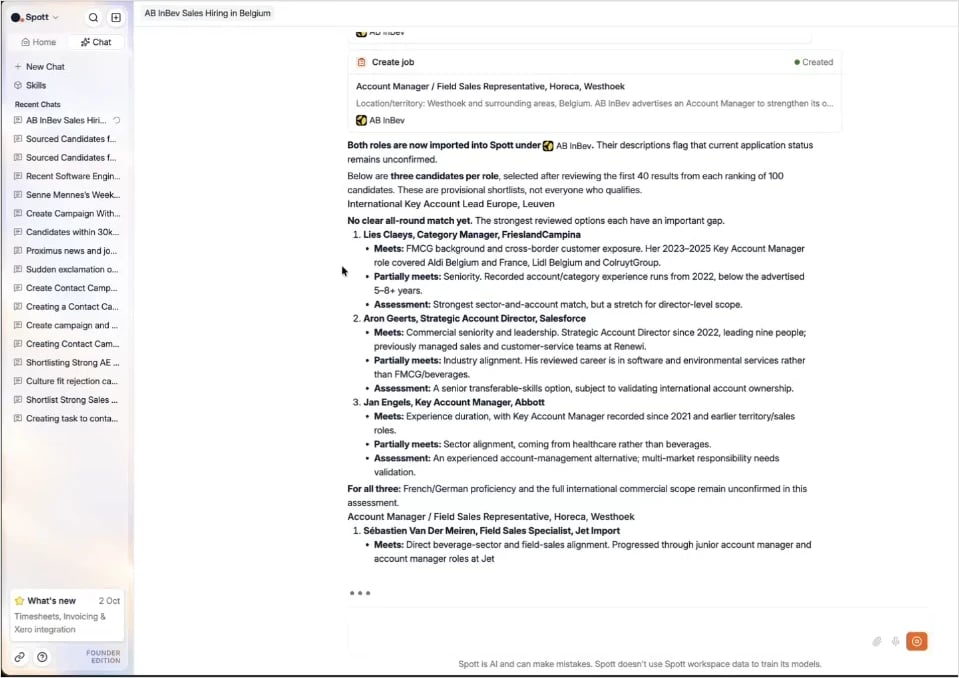
When the information you need is not in Spott, the chatbot searches the web. It works best for targeted lookups: news about a company, open roles on a specific company’s career page, or the hiring manager for a role. It is not designed to scan the entire job market.One of my clients, AB InBev: are they currently hiring for sales positions in Belgium?You can then import what it found straight into Spott. The chatbot checks whether the company already exists, so you do not get duplicates, and imports the jobs including their description, after your approval. In the same request, you can ask it to match candidates right away:
Yes, these are relevant. Import them into Spott and give me a shortlist of the best candidates in my database for both.Other examples:
I have a call with [company] later today about some jobs. What are the latest news items I can mention?
Find the hiring manager for the [role] position at [company].
Skills
For tasks you do regularly, save the instructions once as a skill and the chatbot follows them every time. Everyone starts with Prep my next meeting and Recap my last call. See Chatbot Skills.Memory: it learns how you work
Telling it your preferences
Give the chatbot an instruction about how you like to work, and it saves it to memory and applies it in all your future chats.Whenever I search for candidates, never put them in table form.Changed your mind? Just say so, and the chatbot updates or removes the memory.
Always write my emails in Dutch.
No, don’t do this actually.
Learning from how you use it
The chatbot also learns on its own. It regularly looks for patterns in how you use it and personalizes itself to you. If you always create a note after moving an application to a new stage, for example, it learns that workflow and suggests it or does it for you. Memories that keep being useful are reinforced, and memories that are never used gradually fade out. That keeps the chatbot focused on what is relevant to you today.Tips for the best results
- Be specific. Mention the stage, job, company or time frame you mean.
- Add context. Briefly say what you are working on when a question is not obviously about recruitment.
- Start a new chat for a new topic. It keeps answers focused.
- Check before approving. Read the approval request to make sure the right records change.
- Use the sources. Click the sources under an answer to see where the information comes from.
- Save what you repeat. Turn recurring requests into a skill, and tell the chatbot your preferences so it remembers them.