

What you can import
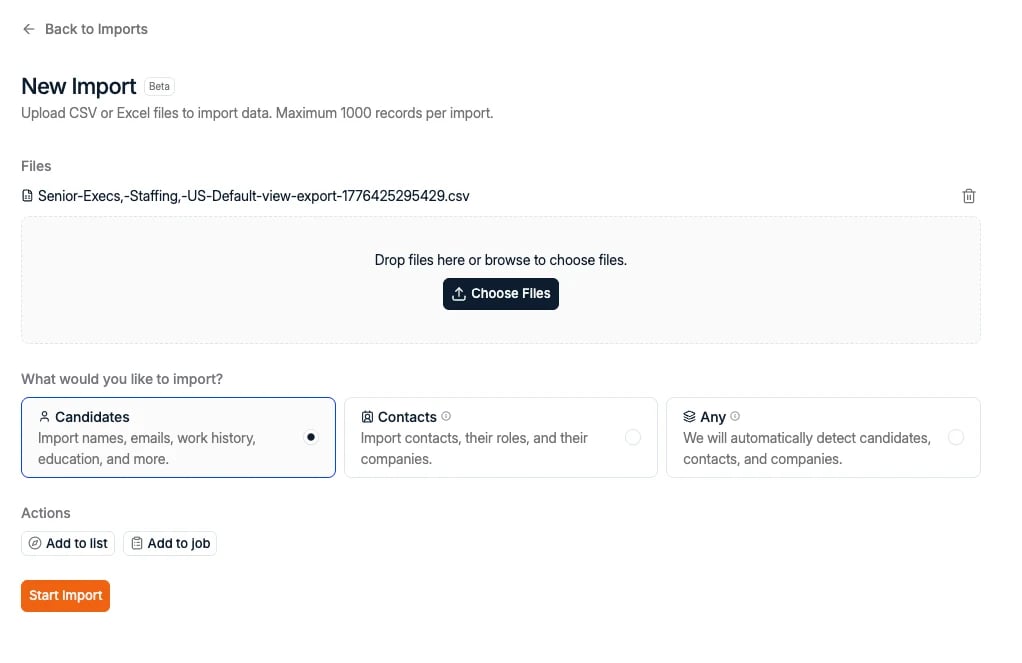
When you upload a file, you choose what the rows represent:Yes, you can import contacts too. The wizard is not candidate-only. Pick
Contacts to bulk-load client contacts, or Any if your file mixes candidates,
contacts, and companies.
Start an import
1
Open the Candidates page
Navigate to Candidates from the main sidebar.
2
Open Import / Export
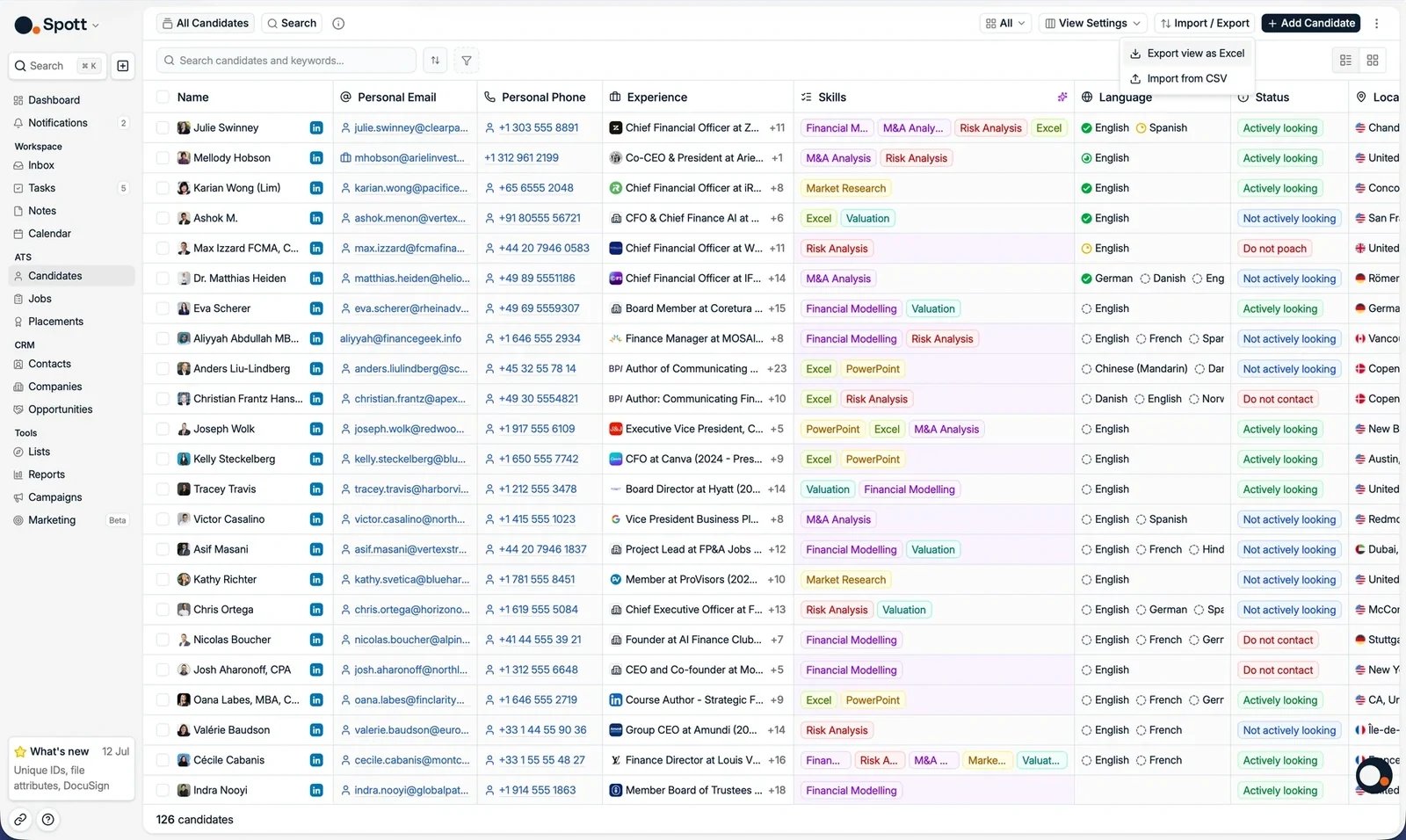
In the top right corner, click Import / Export, then select Import from CSV.
This opens the import wizard. Admins can also reach it from Settings > Import.
3
Upload your file and pick a type
Select the CSV or Excel file from your computer, choose Candidates,
Contacts, or Any, optionally add a List or Job, then click Start Import.
Spott analyzes the file and prepares the mapping.
Map columns to Spott fields
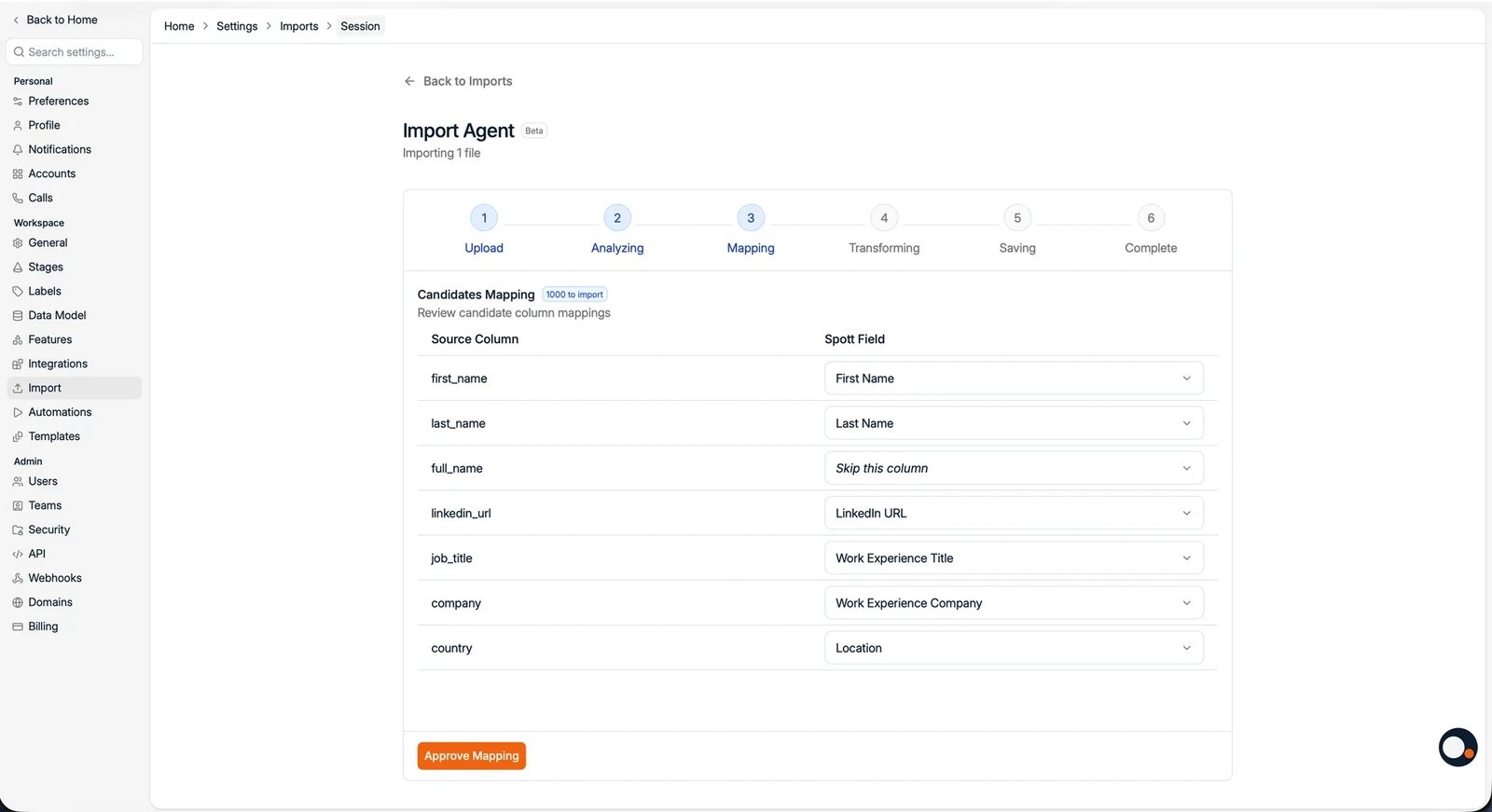
Spott reads your column names and sample data and suggests a mapping for each column automatically. Your headers do not have to match Spott’s field names: “Job Title” is recognized as Work Experience Title, “City” as Location. Review the suggestions and adjust where needed. For each column you can:- Accept the suggested Spott field
- Pick a different Spott field from the dropdown (use the search box at the top)
- Skip the column so it is not imported
Fields you can map to
These are the Spott fields available in the mapping dropdown. The list is complete: if a column has no matching field below, it cannot be imported.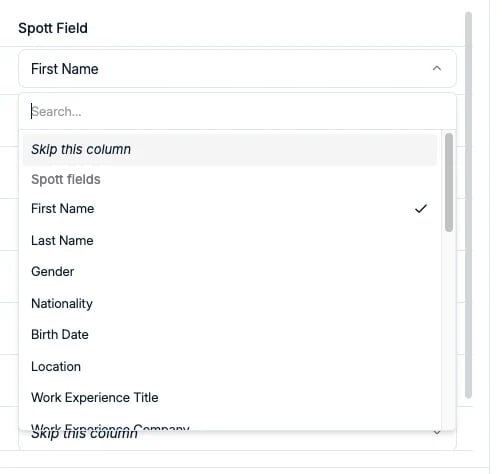
- Person
- Work experience
- Education
- Languages
- Contact details
- Other
There is no Full Name field: split names into a First Name and a Last Name
column. If your file only has a full name column, add the split columns before
uploading and skip the combined one.
Custom fields cannot be mapped. The dropdown only offers the standard fields
listed above, so custom fields your
workspace has configured are not filled by an import. Set those on the records
afterwards.
A row holds a single work experience and a single education entry. To import a full
career history, use a CV upload or the
Chrome extension instead, or enrich the
candidates after the import.
Example file
A file with these headers imports cleanly, without any manual remapping:candidates.csv
Job Title to Work Experience Title, Company to Work Experience
Company, and City to Location. The same file works for a contact import: the
company column is what links each contact to their client company.
Complete the import
Confirm the mapping to start the import. Spott creates a record for every row. After the import completes, the records appear on the Candidates or Contacts page and can be searched, filtered, exported, and added to Lists.An import creates records, it does not update them. When a row matches an
existing person, that person is still added to the Job or List you selected, but
their existing data is not changed by the import.
Company names need an exact match. When a row has no other unique identifier,
companies are matched on name only. Matching is case-insensitive but otherwise
exact: “Acme” and “acme” match, “Acme” and “Acme BV” do not. Spott does keep a
manually curated list of aliases for well-known companies (so “Accenture GmbH”
and “Accenture PLC” resolve to the same company), but for names not on that list,
anything that does not match exactly creates a new company record.
Tips for successful imports
- Include at least one unique identifier per person. Email or LinkedIn URL is recommended, so Spott can deduplicate against existing records.
- Map first name and last name for clean records.
- Remove empty rows before uploading.
- Use UTF-8 encoding for CSV files for best compatibility.
- Use a consistent date format across the file, ideally
YYYY-MM-DD. - Double check email and phone mappings to avoid data landing in the wrong field.
- Importing into a job adds the people as applications, but cannot set their application status or add comments. Set those in the pipeline after the import.
A LinkedIn URL column imports the link to the person’s profile, not the profile
content itself. To pull in full LinkedIn profile data, use the
Chrome extension
or enrichment after the import.
Migrating a full database from another ATS or CRM is a different job, and our team
runs it for you. See Data migration.