Big clients are rarely one company. A group can hold separate legal entities per country, business units with their own hiring managers, and divisions per product line. The Hierarchy tab on a company record connects those records so you can see the whole group from any company inside it, instead of keeping the structure in your head.
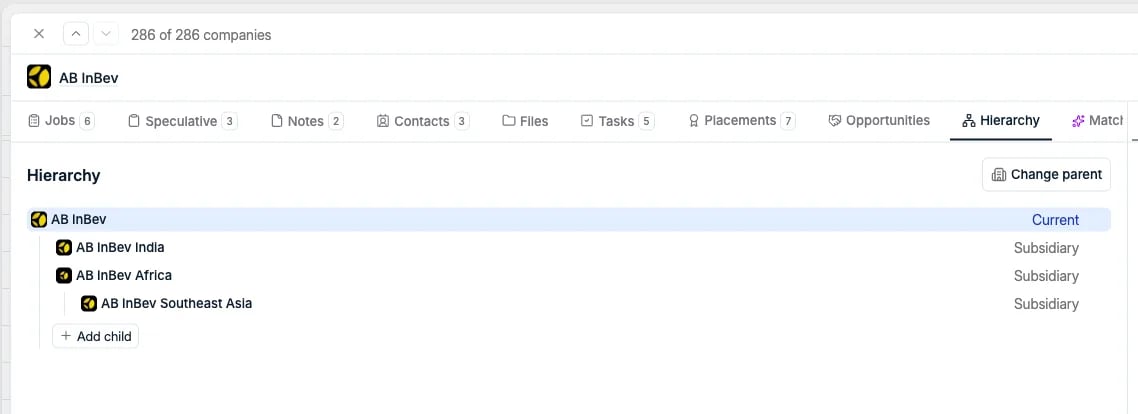
The Hierarchy tab showing a parent company with subsidiaries nested under it
The tab shows the whole group as a tree. The company you are on is marked Current, and every other company shows its relationship to the company above it. Open the Hierarchy tab from any company in the group and you see the same tree.

Add companies to the group

Click Add child to attach the companies that belong to this one. In the Add children dialog, the parent is already filled in. Search for one or more companies, pick the Relation to parent, and click Add children.
The Add children dialog with the parent prefilled, a company search, and a relation to parent field
Use Change parent in the top right to attach the company you are on to a group, or to move it under a different parent. Every company in the tree has a menu with the rest of the actions:
  • Add child: hang another company under that one, which is how you build a tree more than two levels deep.
  • Change relation to parent: correct the relationship type afterwards.
  • Remove from hierarchy: detach that company from the group.
The row menu with Add child, Change relation to parent, and Remove from hierarchy

Types of relationships

The relation is set on the link between a company and its parent, so one group can mix all three. It is required and defaults to Subsidiary.
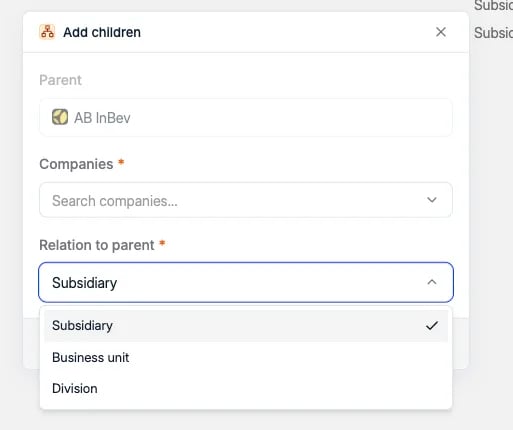
The Relation to parent dropdown with Subsidiary, Business unit, and Division
Picking the right type matters when you report on a client group or need to know which entity actually signs the contract.

Who can change the structure

Building and editing a hierarchy is governed by its own permission, so a role can be allowed to read a client group’s structure without being able to change it. If the Add child, Change relation to parent, and Remove from hierarchy actions are missing or refuse to save, that permission is off for your role. See managing access. Worth restricting on a large account: the tree is shared, so a colleague who reparents one entity changes the structure everyone else is reporting on.

How deep a hierarchy goes

A hierarchy is a tree, not a single parent-child pair. A child company can have its own children, as in the example above where a regional entity sits under another subsidiary, so a group with a holding, national entities, and divisions under those is one connected structure. Each company sits in one hierarchy at a time, with a single parent, which keeps the tree unambiguous.