> ## Documentation Index
> Fetch the complete documentation index at: https://docs.spott.io/llms.txt
> Use this file to discover all available pages before exploring further.
# Use Spott in Claude
> Connect Spott to Claude to run your full recruiting workflow from chat — search candidates, manage pipelines, schedule interviews, send emails, and place candidates without leaving the conversation.
The Spott connector for Claude lets recruiters work in Spott directly from a Claude conversation. Claude can search your candidates, jobs, and companies, move applications through your pipeline, schedule interviews, log calls and notes, send emails, parse CVs, and close placements — all scoped to the authenticated user's tenant and reflected back in the Spott UI in real time.
The connector exposes tools only — there is no separate Spott workspace inside Claude. Every action runs against your live Spott account, and respects the same permissions you have in the Spott UI.
## Prerequisites
* An active Spott workspace with a paid subscription
* A Spott user account with the permissions you'd normally use in the Spott UI
* A Claude account on any plan (Free, Pro, Max, Team, or Enterprise)
## Connect Spott to Claude
In Claude.ai, click the `+` button at the bottom-left of the chat, then choose **Connectors**.
Browse or search for **Spott** in the directory.
Click **Connect**. You'll be redirected to `app.spott.io` to sign in with your Spott credentials.
Review the requested permissions and click **Allow**. You'll be redirected back to Claude.
Click `+` → **Connectors** in your chat and toggle Spott on for this conversation.
Open Claude Desktop → **Settings** → **Connectors**.
Locate Spott in the directory and click **Connect**. The OAuth flow opens in your browser.
Sign in to Spott and authorize the connector.
Back in Claude Desktop, click the `+` button in the chat bar and enable Spott for the conversation.
Tap the `+` icon in the chat bar, then tap **Connectors**.
Find Spott and tap **Connect**. Sign in to Spott when prompted.
Authorize the connector, then enable it for your conversation.
If Spott isn't yet listed in the directory for your client, you can add it as a custom connector with the URL `https://mcp.spott.io/mcp`. Custom connector availability and limits differ by Claude plan.
## Choose what Claude may do
Once connected, Spott appears under **Settings → Connectors**. Open it to see every tool
the connector exposes, grouped into **Read-only tools** (search, lookup, activity) and
write tools (create, update, send).
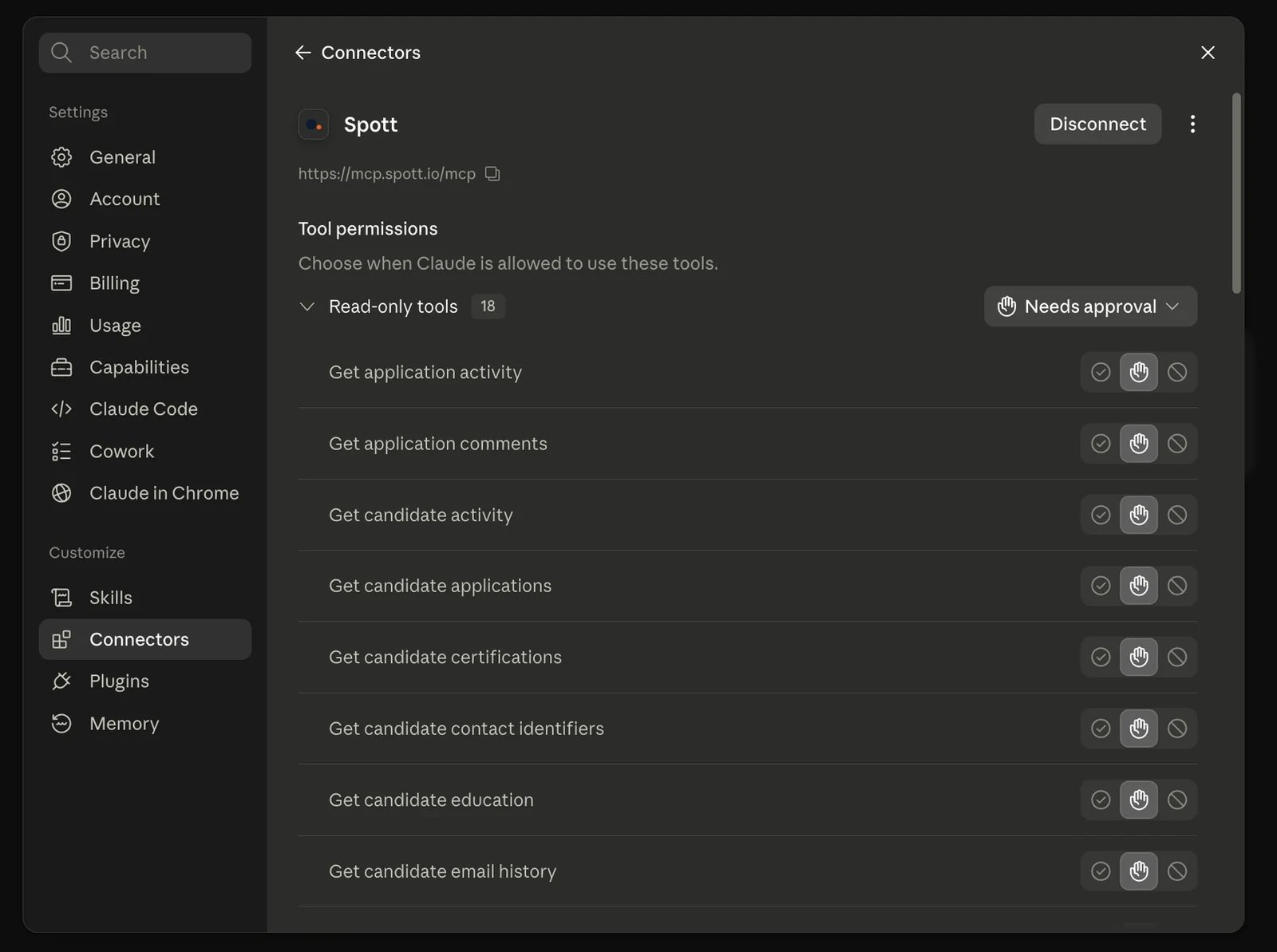 Each tool has three states, set with the icons on the right of its row:
| Icon | State | What it means |
| ----- | -------------- | --------------------------------------------- |
| Check | Always allow | Claude uses the tool without asking. |
| Hand | Needs approval | Claude asks you every time before it runs. |
| Slash | Never allow | The tool is off. Claude cannot use it at all. |
The dropdown next to a group header sets every tool in that group at once. A common
setup is to allow the read-only tools so Claude can look things up freely, and leave the
write tools on **Needs approval** so nothing changes in Spott without your say-so.
Turning a tool off in Claude does not change anything in Spott. It only limits what
this connector can reach.
## What you can do
Ask in plain language, and Claude pulls the answer from your live Spott data.
Each tool has three states, set with the icons on the right of its row:
| Icon | State | What it means |
| ----- | -------------- | --------------------------------------------- |
| Check | Always allow | Claude uses the tool without asking. |
| Hand | Needs approval | Claude asks you every time before it runs. |
| Slash | Never allow | The tool is off. Claude cannot use it at all. |
The dropdown next to a group header sets every tool in that group at once. A common
setup is to allow the read-only tools so Claude can look things up freely, and leave the
write tools on **Needs approval** so nothing changes in Spott without your say-so.
Turning a tool off in Claude does not change anything in Spott. It only limits what
this connector can reach.
## What you can do
Ask in plain language, and Claude pulls the answer from your live Spott data.
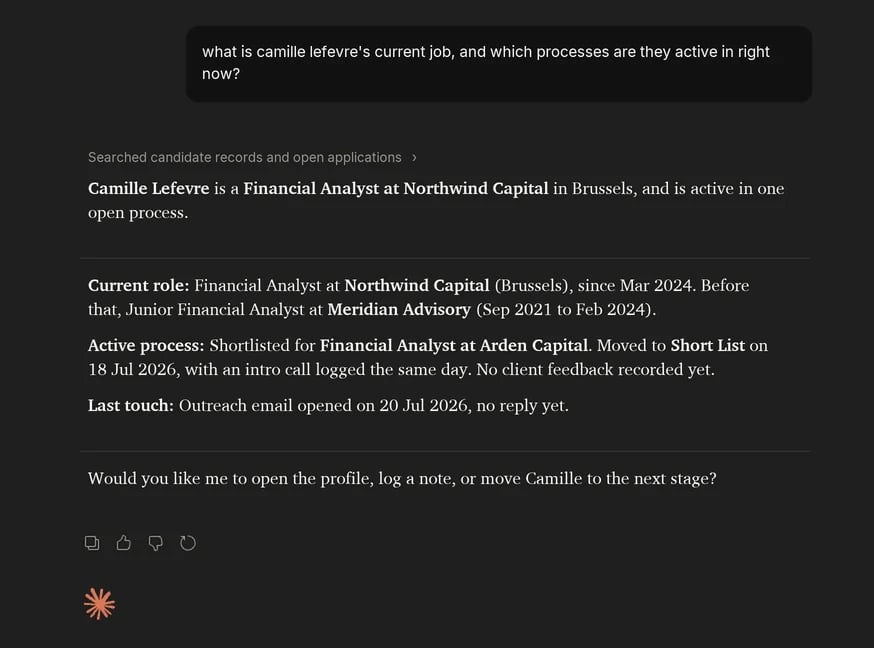 You can use the Spott connector to:
*"Find Python engineers in Brussels with 5+ years of experience"*
*"Move Emma to the offer stage and email her the offer letter"*
*"Book a 30-minute intro between Mario and Dimitri from Forum Jobs tomorrow at 2pm"*
*"Log a call with John yesterday — 3 month notice, €85k, available next week"*
*"Create a candidate from this CV and enrich their email and LinkedIn"*
*"Place Sarah at Google as Senior PM, start date Feb 1, 25% fee"*
## Permissions and data scope
The Spott connector respects every permission and role configured in your Spott workspace. Claude can only see and modify records you have access to in the Spott UI.
* **Tenant isolation:** Each user authenticates with their own Spott credentials. Claude never sees data outside your tenant.
* **Read and write:** The connector includes both read and write tools. Write tools with external side effects (sending emails, scheduling interviews, placing candidates) are flagged so Claude treats them with extra care. You control which tools it may use at all under [Settings → Connectors](#choose-what-claude-may-do).
* **Confirmation for high-impact actions:** Claude will confirm with you before sending external communications or making irreversible changes like placing a candidate or rejecting an application.
## Troubleshooting
Disconnect and reconnect Spott from Claude → **Settings** → **Connectors**. Clear cookies for `app.spott.io` if the issue persists. If your workspace uses SSO, make sure your identity provider session is active before connecting.
Make sure the Spott connector is enabled for the current conversation (`+` → **Connectors**). If you have many connectors active, switch tool access mode to **On demand** to give Claude more room to surface Spott reliably.
The Spott MCP enforces the same permissions as the Spott UI. If you can't see a record in Spott itself, Claude can't either. Ask your workspace admin to grant the required role.
`spott_schedule_interview` schedules an interview against an existing application. If the candidate doesn't have an application on the relevant job yet, create the application first (for example: *"Add Mario as an applicant on the Forum Jobs Senior Backend role"*) and try again.
`spott_place_candidate` advances an existing application to the placed stage. The candidate must already be on a job's pipeline. If they aren't, create the application first.
## Privacy and security
* Spott is hosted in the EU and is GDPR-compliant.
* Customer data is never used to train AI models.
* All data is encrypted in transit (TLS) and at rest.
* A Data Processing Agreement (DPA) is available on request.
For full details, see the [Spott Privacy Policy](https://spott.io/privacy).
## Support
[support@spott.io](mailto:support@spott.io)
docs.spott.io
For Claude-specific connector questions, see [Anthropic's connectors help](https://support.claude.com/en/articles/11176164-use-connectors-to-extend-claude-s-capabilities).
You can use the Spott connector to:
*"Find Python engineers in Brussels with 5+ years of experience"*
*"Move Emma to the offer stage and email her the offer letter"*
*"Book a 30-minute intro between Mario and Dimitri from Forum Jobs tomorrow at 2pm"*
*"Log a call with John yesterday — 3 month notice, €85k, available next week"*
*"Create a candidate from this CV and enrich their email and LinkedIn"*
*"Place Sarah at Google as Senior PM, start date Feb 1, 25% fee"*
## Permissions and data scope
The Spott connector respects every permission and role configured in your Spott workspace. Claude can only see and modify records you have access to in the Spott UI.
* **Tenant isolation:** Each user authenticates with their own Spott credentials. Claude never sees data outside your tenant.
* **Read and write:** The connector includes both read and write tools. Write tools with external side effects (sending emails, scheduling interviews, placing candidates) are flagged so Claude treats them with extra care. You control which tools it may use at all under [Settings → Connectors](#choose-what-claude-may-do).
* **Confirmation for high-impact actions:** Claude will confirm with you before sending external communications or making irreversible changes like placing a candidate or rejecting an application.
## Troubleshooting
Disconnect and reconnect Spott from Claude → **Settings** → **Connectors**. Clear cookies for `app.spott.io` if the issue persists. If your workspace uses SSO, make sure your identity provider session is active before connecting.
Make sure the Spott connector is enabled for the current conversation (`+` → **Connectors**). If you have many connectors active, switch tool access mode to **On demand** to give Claude more room to surface Spott reliably.
The Spott MCP enforces the same permissions as the Spott UI. If you can't see a record in Spott itself, Claude can't either. Ask your workspace admin to grant the required role.
`spott_schedule_interview` schedules an interview against an existing application. If the candidate doesn't have an application on the relevant job yet, create the application first (for example: *"Add Mario as an applicant on the Forum Jobs Senior Backend role"*) and try again.
`spott_place_candidate` advances an existing application to the placed stage. The candidate must already be on a job's pipeline. If they aren't, create the application first.
## Privacy and security
* Spott is hosted in the EU and is GDPR-compliant.
* Customer data is never used to train AI models.
* All data is encrypted in transit (TLS) and at rest.
* A Data Processing Agreement (DPA) is available on request.
For full details, see the [Spott Privacy Policy](https://spott.io/privacy).
## Support
[support@spott.io](mailto:support@spott.io)
docs.spott.io
For Claude-specific connector questions, see [Anthropic's connectors help](https://support.claude.com/en/articles/11176164-use-connectors-to-extend-claude-s-capabilities).